If you have ever searched for how to improve reaction time, you have seen the miracle claims. Here is the honest version: you can get measurably faster — most adults gain 10–30 ms from better sleep, regular short practice, and lower device lag, and occasionally more when they fix a bad setup or start untrained. Anyone promising a 100 ms jump from a single trick is selling noise. Below are the eight methods that research and sports practice actually support, each with exactly what to do and how long it takes to work. Set your baseline first with our reaction time test, then work the list. For what the training-transfer research does and does not support, read our reaction time training guide.
1. Measure your baseline first
Every improvement method is invisible without a starting number. Run two or three rounds on the reaction time test, note your best five-attempt average, and check how it maps onto the published averages on our average reaction time page. From now on, always re-test on the same device at a similar time of day, or you will be comparing your mouse against your phone.
- How: 2–3 rounds of five attempts, seated, alert, on your usual device. Record the best average.
- How long until it works: No effect — this is the ruler every other method is measured against.
2. Best games and drills to improve reaction time
Reaction speed is partly a trained skill: studies of action video game players find they respond faster than non-players on attention tests without losing accuracy (Dye, Green & Bavelier, 2009), and controlled training improves visual processing speed in as little as ten hours of play spread over two weeks (Green & Bavelier, 2003, Nature). The transfer is modest and task-specific — you get fast at what you train — so train the thing you care about: ten to fifteen minutes a day of reaction drills, aim training, or ball sports, beats a two-hour weekend binge.
- How: 10–15 minutes daily: a reaction test warm-up, then aim trainers, juggling, table tennis, or fast-paced games that punish slow responses.
- How long until it works: Visible gains in 1–2 weeks; most people plateau after 4–6 weeks of regular practice.
3. Protect your sleep
Sleep is the single biggest lever. After 17–19 hours awake, reaction performance matches a blood alcohol level of about 0.05% (Dawson & Reid, 1997), and two weeks of six-hour nights degrades attention as much as one or two nights of total sleep loss (Van Dongen et al., 2003). A bad night routinely costs 20–50 ms — more than every training method on this page combined. Esports teams treat sleep as equipment for exactly this reason. Our sleep deprivation and reaction time guide explains the PVT evidence and why lapses matter more than a small shift in the average.
- How: 7–9 hours, consistent schedule, no all-nighters before days that matter. Treat the night before a competition like part of training.
- How long until it works: One good night shows up the very next day; chronic sleep debt takes several consistent nights to clear.
4. Warm up before you test or play
Cold fingers and a cold nervous system are slow ones. Two or three easy practice rounds before any round you care about reliably improve the number, both by raising alertness and by re-familiarizing your hand with the exact movement. Athletes warm up before sprinting; reaction is a sprint for your nervous system.
- How: Before a serious attempt: 2–3 relaxed practice rounds, plus a minute of light hand and wrist movement. Never treat your first attempt of the day as your real score.
- How long until it works: Immediately — this is a same-minute effect.
5. Cut screen and input lag
A meaningful slice of your score is not biology — it is hardware. A 60 Hz monitor redraws only every 16.7 ms; input and display processing add roughly 30 ms on a typical desktop (per Human Benchmark's notes). A wired mouse at 1000 Hz polling on a 120–144 Hz screen in game mode can recover 10–40 ms before your nerves change at all. This is the cheapest "improvement" available, and it is fully within your control.
- How: Use a wired mouse (or low-latency wireless) at 1000 Hz polling, enable your monitor's game/low-latency mode, set the highest practical refresh rate, disable heavy background apps while testing, and keep the browser tab in focus.
- How long until it works: The very next click — this is immediate.
6. Time your caffeine
Caffeine is the most studied performance drug in the world, and the finding most relevant here is boring: in rested and sleep-deprived adults alike, a moderate dose reliably speeds simple reaction time and vigilance (Einöther & Giesbrecht, 2013). It is a small, real effect rather than a superpower, and its size varies with sleep, tolerance and dose. For the dose, timing, tolerance and withdrawal caveats, read our caffeine and reaction time evidence guide. Avoid late-day doses that borrow from tonight's sleep, because rule 3 will collect the debt with interest.
- How: If you use caffeine, keep your usual dose and timing consistent before test sessions. Skip energy-dose escalation — the effect does not scale, and tolerance builds.
- How long until it works: 30–60 minutes after the cup; lasts a few hours.
7. Train your eyes and attention
Reaction time is mostly a story about attention. Skilled performers in fast sports don't have dramatically faster nerves — they extract the signal earlier: goalkeepers read a kicker's hips, racing drivers watch the braking point, FPS players hold crosshair placement so the reaction is short. "Quiet eye" training — keeping your gaze locked on the decisive spot — measurably improves response in ball sports, and the same discipline pays on a screen: eyes on the test area, mind on the signal, not on your finger. The most controlled version of this idea is stroboscopic visual training — practicing while vision-flickering glasses force your brain to work with less information: a 2025 meta-analysis of 9 studies with 323 athletes found it significantly improved reaction time (though not decision-making), with the clearest programs running 1–6 weeks of short, frequent sessions.
- How: During practice, fix your gaze on where the signal will appear instead of scanning. In games, pre-aim common angles so only a small correction remains. Ten deliberate minutes a day.
- How long until it works: 2–4 weeks of deliberate practice before it becomes automatic.
8. Move your body
Aerobic fitness has a well-documented relationship with processing speed: reviews of the exercise-cognition literature find that regular moderate cardio improves reaction time and executive function across age groups (Hillman, Erickson & Kramer, 2008, Nature Reviews Neuroscience). You do not need athlete volumes — thirty minutes of brisk movement, most days, is enough to keep the machinery responsive, and it compounds with the sleep benefits. In esports specifically, a 2026 meta-analysis of 10 randomized controlled trials with 503 players found exercise interventions significantly reduced reaction time while also improving accuracy — with exergame-style formats edging out plain aerobic exercise.
- How: 30 minutes of moderate cardio (brisk walk, cycle, swim) at least 3–5 days a week.
- How long until it works: Expect measurable cognitive effects after several weeks of consistency, not after one run.
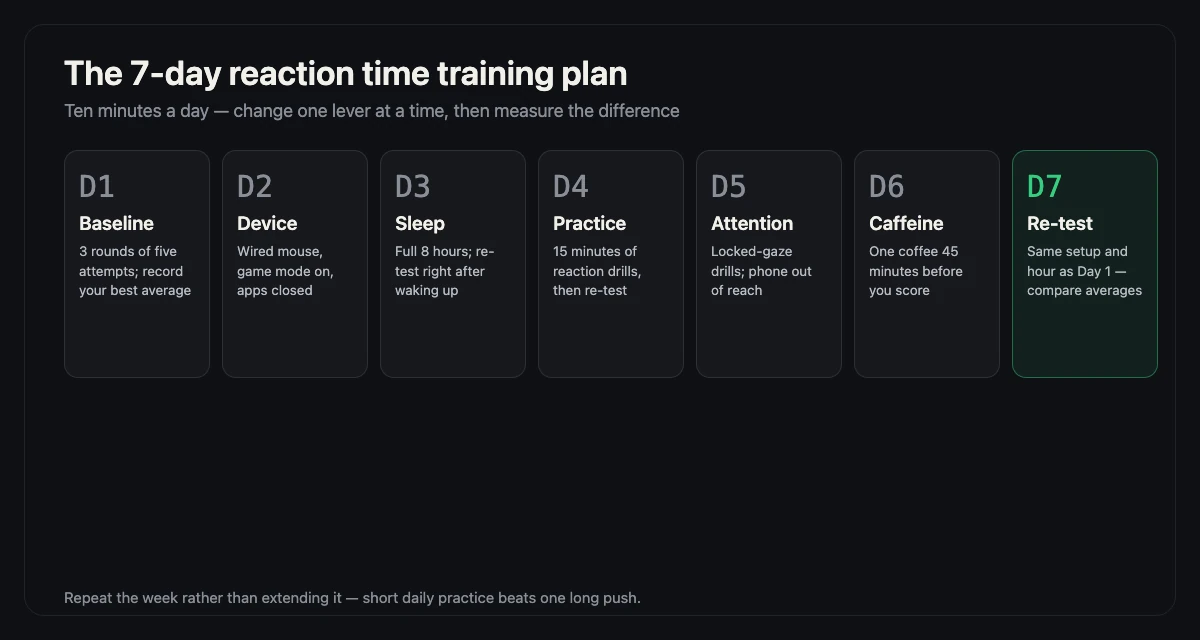
Your 7-day plan to improve reaction time
Here is the whole program assembled — one focused change per day, about ten minutes each, with a re-test at both ends. Days 1 and 7 are the measurement; the days between move one lever at a time so you can see what actually helps you.
| Day | Focus | What to do | What to expect |
|---|---|---|---|
| 1 | Baseline | 3 rounds of five attempts on the reaction time test; record your best average | Your reference number |
| 2 | Device | Wired mouse, game mode on, background apps closed; re-test | Often 10–40 ms immediately |
| 3 | Sleep | Full 8 hours tonight; re-test tomorrow morning, right after waking up | Noticeable if you were short on sleep |
| 4 | Practice | 15 minutes of reaction drills or fast games; re-test after a short break | Warm-up effect + task learning |
| 5 | Attention | Drills with locked gaze on the signal area; no phone within reach | Fewer slow, distracted attempts |
| 6 | Caffeine + warm-up | Usual caffeine routine (if any); 3 relaxed warm-up rounds, then score | A small, reliable afternoon boost |
| 7 | Re-test | Same device, same time of day as Day 1: 3 rounds, compare averages | Your real, earned improvement |
Repeat the week rather than extending it — consistent short practice beats one long push. Log your averages; the trend line is the reward loop.
What the research says (and doesn't)
It is worth separating what is proven from what is merely plausible:
- Well supported. Sleep, caffeine, aerobic exercise, and task-specific practice all move reaction time in controlled studies — modestly, but they replicate. Structured visual training works too: a 2025 randomized controlled trial in older adults found balance-based visual reaction exercises significantly improved reaction time and physical performance, even though global executive function did not change.
- Plausible but thinner. Warm-ups, gaze discipline, and cutting device lag are grounded in solid physiology and every coach's experience, but their individual effect sizes are rarely isolated in trials.
- Mostly anecdote. Supplements marketed for "reflexes" and general brain-training subscriptions lack convincing evidence for reaction time.
And one caution that applies to every method on this page, including ours: a 2025 meta-analysis of 33 randomized controlled trials found that when digital training and the test used to measure it are similar, reported gains are several times larger (for reaction time, SMD 2.66 versus 0.50) than when training and testing are different tasks. In plain terms: getting better at a test is not the same as getting faster in life. Practice on the ReflexTimer test will improve your ReflexTimer score; treat transfer to the game, court, or road as a separate claim that only sport-specific practice earns.
What not to waste money on
- "Brain training" subscriptions that promise broad speed gains. People improve at the trained games robustly; transfer to everyday reaction speed is small and contested. Play action games or train the actual task instead — it is cheaper and better targeted.
- Supplements marketed for "reflexes." None have convincing human evidence for reaction time beyond correcting an actual deficiency.
- Autoclickers and reaction bots. They fabricate the number, pollute every leaderboard they touch, and defeat the only purpose the test has.
Track your progress honestly
Retest weekly, same device, similar hour, and compare five-attempt averages — never single best attempts, which mostly track luck. If your average trends down over a month, the program is working; if it stalls, the biggest remaining levers are usually sleep and lag, not more drills. That is how to improve reaction time in practice: measure honestly, change one lever at a time, and let the trend line make the case. For context on where your numbers sit, revisit the average reaction time page, and if you also want faster hands rather than faster eyes, the CPS test trains clicking speed with the same test-then-train loop.
Frequently asked questions
How much can I realistically improve my reaction time?
Most adults can shave off roughly 10–30 ms with better sleep, regular short practice, and lower device lag — sometimes more if they started untrained or on a slow setup. Claims of 50–100 ms gains from any single trick are marketing, not physiology.
How long does it take to get better reaction time?
Sleep and device changes show up the very next day. Structured practice typically produces visible gains within 1–2 weeks and plateaus after about 4–6 weeks of regular short sessions.
Can you improve reaction time after 40?
Yes. Controlled studies found older adults improve processing speed with training just as younger adults do — including a study where older adults gained cognitive flexibility from several weeks of strategic video game play. Age slows raw speed, but practice still pays.
Do reaction time apps and brain games work?
They work for the specific game you practice, and action-style games transfer modestly to general processing speed. Be skeptical of anything promising large, broad gains from a single app — task-specific improvement is the consistent finding in research.
Is reaction time genetic or trainable?
Both. Your raw ceiling is partly inherited, but day-to-day variation — often 20–50 ms — is dominated by controllable factors: sleep, caffeine, attention, warm-up, and device lag. That controllable band is exactly what the methods on this page move.
For the measurement side of improvement — timing error, device latency, reliability — start from the full guides index.
References
- Dawson, D., & Reid, K. (1997). Fatigue, alcohol and performance impairment. Nature, 388, 235.
- Van Dongen, H. P. A., Maislin, G., Mullington, J. M., & Dinges, D. F. (2003). The cumulative cost of additional wakefulness. Sleep, 26(2), 117–126.
- Einöther, S. J. L., & Giesbrecht, T. (2013). Caffeine as an attention enhancer: reviewing existing evidence. Psychopharmacology, 225(2), 251–274.
- Green, C. S., & Bavelier, D. (2003). Action video game modifies visual selective attention. Nature, 423, 534–537.
- Dye, M. W. G., Green, C. S., & Bavelier, D. (2009). Increasing speed of processing with action video games. Current Directions in Psychological Science, 18(6), 321–326.
- Glass, B. D., Maddox, W. T., & Love, B. C. (2013). Real-time strategy game experience: Cognitive and perceptual. Cognitive Science, 37(5), 992–1013.
- Hillman, C. H., Erickson, K. I., & Kramer, A. F. (2008). Be smart, exercise your heart. Nature Reviews Neuroscience, 9, 58–65.
- Human Benchmark reaction time statistics and input/display latency notes.
- Effects of stroboscopic visual training on reaction time and decision-making ability in athletes: a systematic review and meta-analysis. Frontiers in Psychology (2025).
- Does the "learning effect" caused by digital devices exaggerate sports visual training outcomes? A systematic review and meta-analysis. Frontiers in Physiology (2025).
- Exercise interventions and multidimensional cognitive function in esports players: a systematic review and meta-analysis of randomized controlled trials. Frontiers in Psychology (2026).
- Effects of balance-based visual reaction time exercises on cognitive and physical performance in older adults: a randomized controlled trial. Scientific Reports (2025).